The gravel formula in three lines
- Square feet = length × width
- Cubic yards = square feet × (depth in inches ÷ 12) ÷ 27
- Tons = cubic yards × weight per yard (about 1.4 for general gravel)
Then add 5 to 10 percent so you don’t run short.
Depth in feet for common depths:
| Depth | In feet |
|---|---|
| 1 inch | 0.083 |
| 2 inches | 0.167 |
| 3 inches | 0.25 |
| 4 inches | 0.333 |
| 6 inches | 0.5 |
Worked examples
Garden path, 40 × 3 ft, 3 inches deep
- Area: 40 × 3 = 120 sq ft
- Volume: 120 × 0.25 = 30 cu ft = 1.1 cubic yards
- Weight: 1.1 × 1.4 = about 1.6 tons
Patio, 12 × 12 ft, with a base
- Base, 4 inches of crusher run: 144 × 0.333 = 48 cu ft = 1.8 cubic yards, about 2.7 tons
- Top, 2 inches of pea gravel: 144 × 0.167 = 24 cu ft = 0.9 cubic yards, about 1.3 tons
Order each layer separately; they are different stone. The pea gravel calculator and crusher run calculator have the right weights loaded.
Shed base, 10 × 12 ft shed, 6 inches deep
Make the pad about a foot wider than the shed on every side, so 12 × 14 ft.
- Area: 168 sq ft
- Volume: 168 × 0.5 = 84 cu ft = 3.1 cubic yards
- Weight in #57 crushed stone: 3.1 × 1.35 = about 4.2 tons
Circular fire pit area, 16 ft across, 3 inches deep
- Area: 3.14 × 8 × 8 = 201 sq ft (subtract the fire pit itself if it is large)
- Volume: 201 × 0.25 = 50 cu ft = 1.9 cubic yards
- Weight: about 2.6 tons
Bed along a house, 60 × 3 ft, 2 inches deep
- Area: 180 sq ft
- Volume: 180 × 0.167 = 30 cu ft = 1.1 cubic yards, or 60 bags of 0.5 cu ft
Quick reference: cubic yards per 100 square feet
| Depth | Cubic yards per 100 sq ft | Tons per 100 sq ft (general gravel) |
|---|---|---|
| 2 inches | 0.62 | about 0.86 |
| 3 inches | 0.93 | about 1.3 |
| 4 inches | 1.23 | about 1.7 |
| 6 inches | 1.85 | about 2.6 |
Scale it up: a 500 sq ft area at 3 inches is 5 × 0.93 = 4.6 cubic yards.
Measuring in meters?
Multiply square meters by depth in meters to get cubic meters. One cubic yard is 0.765 cubic meters, and general gravel weighs about 1.6 to 1.7 tonnes per cubic meter. A 20 m² area at 50 mm deep is 1 m³, or about 1.65 tonnes.
How to measure without mistakes
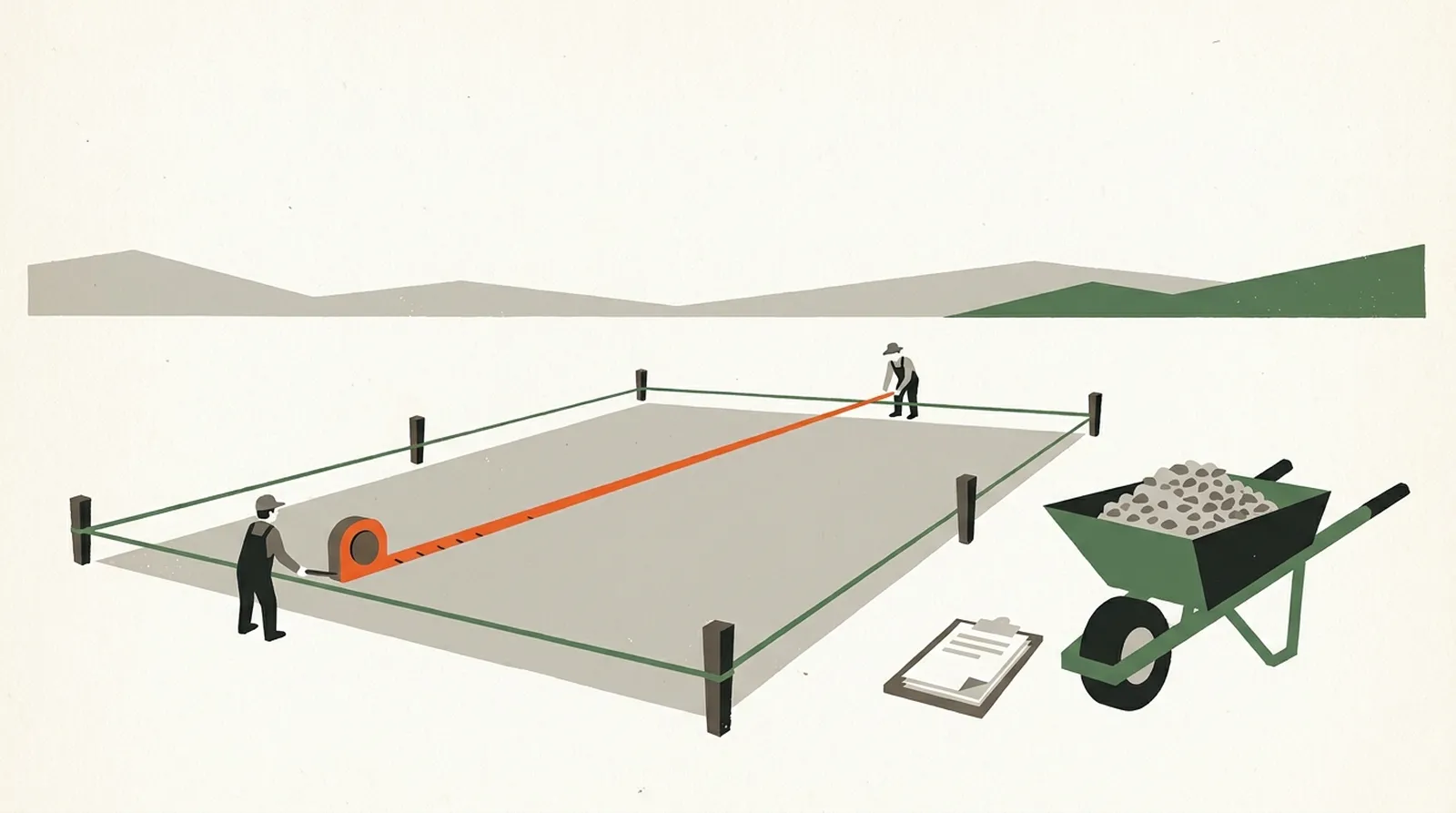
- Measure in feet, and convert inches to decimals (6 inches = 0.5 ft).
- For a curved bed, measure its length along the middle and take an average of several widths.
- Check depth in a few places if you are topping up existing gravel; you only need to fill the difference.
- Round up to the next half or whole cubic yard. Most suppliers sell in those steps, and a little left over is useful for touch-ups.
Use your supplier's weight per yard when you order by the ton. Their stone, and whether it is washed or wet, can move the number by 10 percent or more.
Questions people ask
- How do I calculate how much gravel I need?
- Length (ft) × width (ft) × depth (in) ÷ 12 gives cubic feet. Divide by 27 for cubic yards. Multiply cubic yards by about 1.4 for tons of general gravel.
- How many yards of gravel do I need for 100 square feet?
- At 2 inches deep, about 0.62 cubic yards. At 3 inches, 0.93 cubic yards. At 4 inches, 1.23 cubic yards.
- How many tons of gravel do I need?
- Work out cubic yards first, then multiply by the stone's weight per yard. General gravel is about 1.4 tons per cubic yard, so 3 cubic yards is about 4.2 tons.
- How do I measure an irregular area?
- Split it into rectangles, triangles and circles, work out each area, and add them together. For a triangle, multiply base × height and divide by 2.